
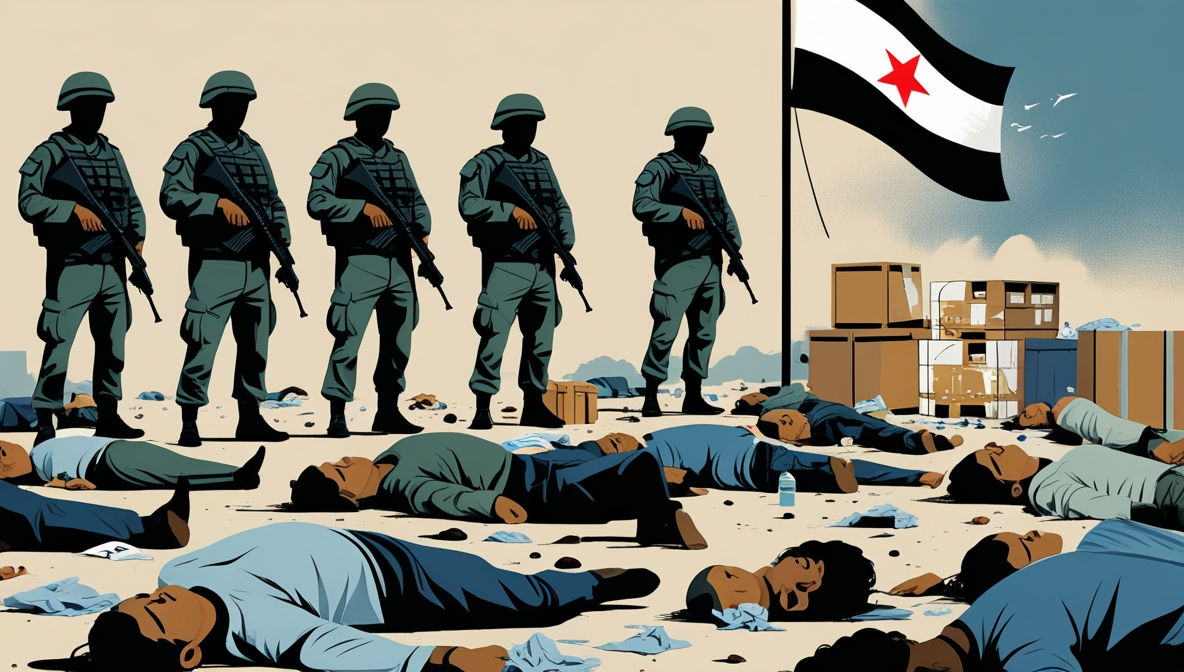
The Hamas-run Ministry of Health reported that Israeli forces killed at least 67 people waiting for UN humanitarian aid trucks in northern Gaza.
The UN World Food Programme said its convoy of 25 trucks "encountered huge crowds of hungry civilians who came under fire" shortly after crossing the Israeli border and passing checkpoints.
The Israel Defense Forces (IDF) said it "fired warning shots" to remove an "immediate threat" and denied the reported death toll.
On Saturday, the health ministry warned that an acute hunger crisis is escalating in Gaza, with more people arriving at medical facilities in extreme exhaustion and fatigue.
"We warn that hundreds of people, whose bodies are emaciated, face imminent death from hunger," the statement said. The UN also said Gaza's civilian population is starving and called for urgent delivery of essential goods.
On Sunday, 18 deaths "due to hunger" were reported in the past 24 hours.
Another six people died waiting for aid in other parts of Gaza, and over 150 were injured, some seriously, the ministry said. Overall, health authorities said 88 people were killed Sunday due to Israeli fire and airstrikes.
Many of the wounded from northern Gaza were taken to Shifa hospital in Gaza City. The medical director, Dr. Hassan al-Shaer, told BBC Arabic the hospital was "overwhelmed" and was directing the wounded to field hospitals.
Outside the hospital, one woman told BBC Arabic: "The entire population is dying. Children are dying of hunger because they have nothing to eat. People survive only on water and salt."
Since late May, reports of Palestinians dying while searching for food have come almost daily. According to the ministry, on Saturday at least 32 people were killed by Israeli fire near two aid distribution points in southern Gaza.
Many incidents occurred near facilities managed by the controversial Gaza Humanitarian Fund (GHF), backed by the U.S. and Israel, which uses private security contractors to distribute aid from sites in Israeli military zones. Some incidents also occurred near aid delivered by the UN.
Meanwhile, Israeli forces issued evacuation orders from densely populated parts of central Gaza where no ground assault has begun in the 21-month war against Hamas.
On Sunday, the IDF said residents and displaced Palestinians in Deir al-Balah city must evacuate immediately and move to the al-Mawasi area on the Mediterranean coast.
The demand sparked panic among tens of thousands of Palestinians, as well as families of Israeli hostages who fear for their safety since hostages are likely held in the city.
The Israeli army carried out airstrikes in the Deir al-Balah area but has not yet deployed ground troops.
On Sunday, Israeli forces dropped leaflets ordering people in several neighborhoods of southwestern Deir al-Balah to leave their homes and move further south.
"The Israel Defense Forces continue to operate with great force to destroy enemy capabilities and terrorist infrastructure in this area," the military said, adding they have not entered these areas during the war.
The affected areas of Deir al-Balah are overcrowded with displaced people living in tents.
Israeli sources told Reuters the army has not entered these areas due to suspicions Hamas may be holding hostages there.
It is believed that at least 20 of the 50 hostages still held captive in Gaza are alive.
Most of Gaza's population of over two million has been displaced at least once during the war, and numerous Israeli evacuation calls have covered significant areas.
On Sunday, Pope Leo XIV called for an "immediate end to the barbarity of war" and condemned the "indiscriminate use of force."
His remarks came days after a deadly Israeli strike on Gaza's only Catholic church. Israeli Prime Minister Benjamin Netanyahu expressed deep condolences over the incident.
Israel launched the war in Gaza in response to Hamas attacks on October 7, 2023, which killed about 1,200 people and took 251 hostages.
According to the Hamas-run health ministry, more than 58,895 people have died in Gaza from Israeli attacks since then. These figures are cited by the UN and other organizations as the most reliable source of casualty statistics.